

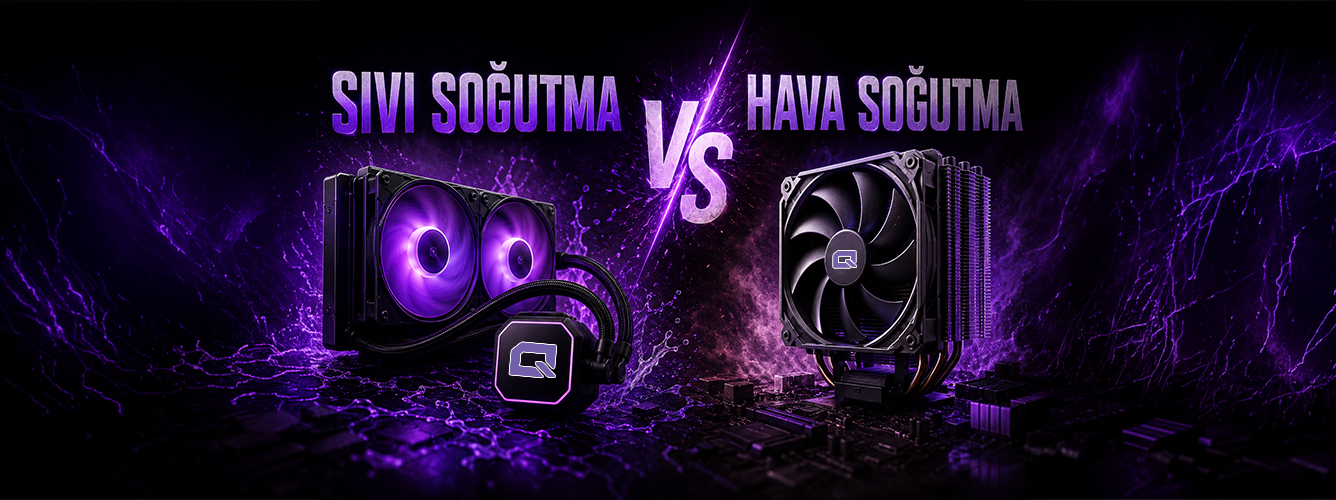
Liquid Cooling vs Air Cooling
Liquid Cooling vs Air Cooling: Which Makes More Sense?
Behind this question, most gamers are really asking: “Does liquid cooling just look better, or does it actually perform better?” Understanding the distinction helps you use both your budget and the space inside your case wisely.
Air Cooling Is Different, Not Outdated
A tower cooler may look like the traditional option, but high-end air coolers outperform many 240mm AIO liquid coolers. That can be surprising if you have not heard it before.
Air cooling works by using copper heatpipes to carry heat away from the processor to aluminum fins. A fan then pushes air through those fins to dissipate the heat. There are very few moving parts, usually just the fan. That means fewer moving parts and fewer potential points of failure.
For example, pairing a good tower cooler with an upper-mid-range processor such as the Ryzen 7 7800X3D can work comfortably through long gaming sessions. Temperatures stay around 70–75°C, the system remains quiet and fan noise is unobtrusive.
Where Does Liquid Cooling Have a Real Advantage?
AIO (All-in-One) liquid coolers can clearly outperform air coolers in two particular situations.
Intel Core Ultra 9 and AMD Ryzen 9 class processors produce a substantial amount of heat under load. In particular, 360mm AIO solutions help these processors sustain high performance for longer.
Large tower coolers can sometimes create clearance issues with RAM or the case. An AIO moves its radiator to the front or top of the case, leaving a more open interior.
But Can Liquid Cooling Leak?
People have asked this question for years. Older products occasionally suffered from leaks, but the risk is now quite low with modern AIO models.
Still, an AIO has both a pump and fans, while an air cooler generally has only a fan. That theoretically gives an AIO slightly more ways to fail, although a quality model can run reliably for many years.
Which Is Really Quieter?
The idea that liquid cooling is always quieter is not necessarily true.
An AIO runs its radiator fans and pump together. Fan speeds can climb under load and produce more noise than expected. A low-level pump hum can also be noticeable in a quiet room.
A quality air cooler, by contrast, can run extremely quietly with large fans at low speeds. If silence matters to you, consider the quality of the components as well as the cooling method.
What About Price?
Air coolers are generally more affordable. At comparable performance levels, liquid cooling often costs more.
If you use a Ryzen 5 or Core i5 class processor, spending the extra cooling budget on a faster SSD or more RAM may make a more noticeable difference in everyday use.
With high-end processors such as a Ryzen 9 or Core Ultra 9, however, the additional thermal capacity of a quality 360mm AIO can provide a real advantage.
What If You Are Buying a Prebuilt PC?
Prebuilt manufacturers generally optimize the CPU and cooler pairing in advance, so the balance is already established for most users.
In mid-range systems, capable air coolers offer a sensible balance of cost and quiet operation. In high-end systems, 360mm liquid coolers are used to meet the demands of more powerful processors.
Conclusion
There is no single answer to which cooling method is best. Your CPU's power consumption, case size, budget and aesthetic preferences all matter. With the right pairing, both a quality air cooler and a good AIO can serve reliably for years.