

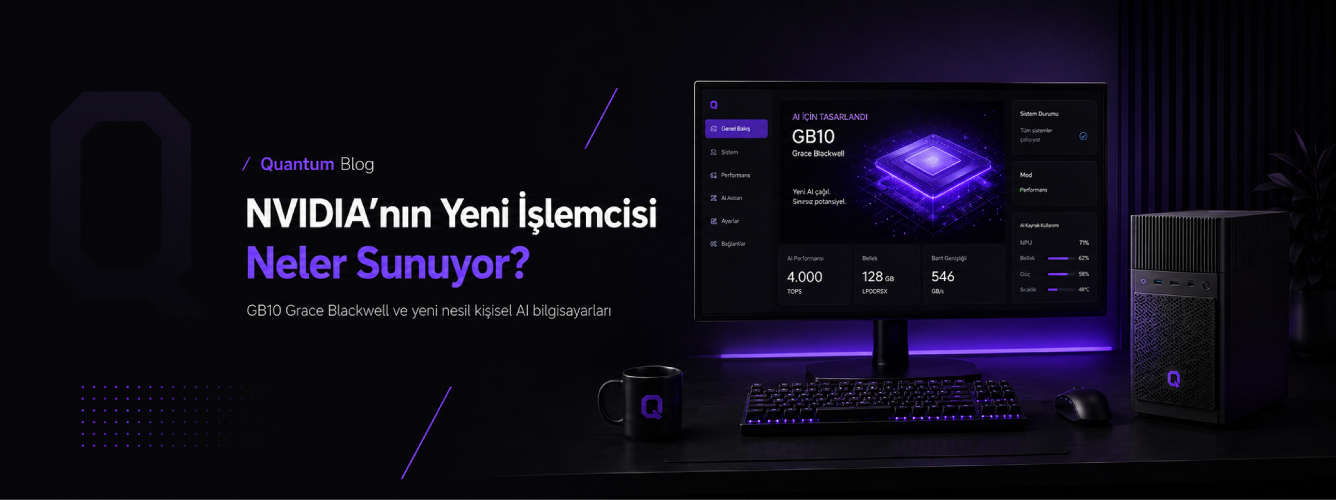
Is NVIDIA Entering the PC Processor Market?
What Does NVIDIA's New Processor Offer?
When most people hear NVIDIA, they first think of GeForce graphics cards. But the company is no longer focused solely on GPUs. Its new generation of compact AI computers using Grace Blackwell architecture brings a processor, graphics hardware and high-capacity memory together in one system.
At the heart of these systems, the NVIDIA GB10 Grace Blackwell Superchip is designed to run large AI models locally without relying on cloud services. All of that capability fits into a compact device that takes up very little desk space.
- 20-core ARM-based Grace CPU
- NVIDIA GPU with Blackwell architecture
- Up to 128GB of unified memory
- Around 1 petaflop of FP4 AI performance
- Support for running large language models locally
- CUDA and TensorRT software support
What Is the GB10 Grace Blackwell Superchip?
GB10 Grace Blackwell is an integrated computing platform NVIDIA developed for personal AI computers. In a traditional PC, the CPU and graphics card are separate components; GB10 creates a much closer connection between them.
The processor is a 20-core Grace CPU based on ARM architecture and developed with MediaTek. An NVIDIA Blackwell-based GPU handles graphics and AI computation.
- CPU: 20-core ARM-based Grace processor
- GPU: NVIDIA graphics hardware with Blackwell architecture
- Memory: Up to 128GB of unified system memory
- Performance: Around 1 petaflop of FP4 AI processing power
- Platform: NVIDIA CUDA and AI development tools
This architecture is intended to accelerate data transfer between the CPU, GPU and memory, particularly for large AI models.
128GB of VRAM or Unified Memory?
One of the systems' most striking features is memory capacity of up to 128GB. However, calling it 128GB of graphics card memory is not entirely accurate.
The system uses unified memory, with the CPU and GPU accessing the same pool. This reduces the need to copy data continually between system RAM and graphics memory.
Advantages of Unified Memory
- Makes it easier to fit large models into memory.
- Reduces data copying between CPU and GPU.
- Can provide a more efficient design for AI workloads.
- Helps overcome the VRAM limits of conventional consumer graphics cards.
Many gaming graphics cards are limited to 16GB, 24GB or 32GB of VRAM. With large language models, the model file alone can exceed those capacities. A major advantage of GB10-based systems is the ability to run larger models locally using a substantial pool of unified memory.
What Does 1 Petaflop of AI Performance Mean?
NVIDIA says the GB10 platform can deliver approximately 1 petaflop of AI processing power in the FP4 data format.
FP4 is a low-precision number format used in AI models. It lets model data use less memory and be processed faster on compatible hardware.
This performance level targets workloads such as:
- Running large language models
- AI image generation
- Developing AI agents
- Robotics and simulation
- Model prototyping and testing
- Image and video analysis
How Large a Model Can It Run?
According to NVIDIA, a single GB10-based system will be able to run AI models with up to approximately 200 billion parameters using suitable compression and low-precision methods.
Connecting two devices over a high-speed link may also make it possible to work with larger models.
| System Configuration | Intended Use |
|---|---|
| One device | Large language models, image generation and AI development |
| Two devices | Larger models and projects requiring more memory |
Parameter count alone is not enough to determine compatibility. The model's data format, context length, cache requirements and software optimizations also directly affect memory usage.
Designed for More Than Chatbots
GB10-based devices are intended for more than a ChatGPT-style chat interface. NVIDIA places particular emphasis on AI agents and professional AI applications.
AI agents can analyze a user's task, create a plan, use different software tools and carry out specific operations.
What Can an AI Agent Do?
- Analyze documents and company data.
- Write code and investigate software errors.
- Prepare draft reports and presentations.
- Generate images or video content.
- Analyze camera footage.
- Monitor production and logistics processes.
- Automate tasks across different applications.
Running these tasks locally can offer businesses advantages in data privacy, low latency and operation without relying on an internet connection.
NVIDIA's Biggest Advantage: Its Software Ecosystem
One of NVIDIA's main strengths is not just powerful hardware but the extensive software ecosystem it has developed over many years.
- CUDA: A platform for developing GPU-accelerated applications
- TensorRT: Infrastructure for optimizing and accelerating AI models
- NVIDIA NIM: Tools for serving AI models
- NVFP4: Low-precision AI computation support in Blackwell architecture
- RTX: Graphics, ray tracing and content-creation technologies
The widespread use of CUDA in universities, data centers and AI projects can make it easier for developers to bring their existing work to these devices.
Can It Replace a Gaming PC?
Because GB10 includes a Blackwell-based NVIDIA GPU, it can technically run graphics applications and some games. Gaming performance, however, is not its main purpose.
Its priorities are:
- Fitting large AI models into memory
- Running AI development tools locally
- Providing high capacity in a compact case
- Enabling fast CPU-to-GPU data transfer
- Bringing professional AI projects to the desktop
Who Is It For?
NVIDIA's new personal AI computers are not standard desktop systems intended for everyone. They primarily target professional users and AI developers.
| User Group | Use Case |
|---|---|
| AI developers | Model development, testing and inference |
| Universities | Academic research and student projects |
| Businesses | Local AI with private data |
| Content creators | Image, video and generative AI applications |
| Robotics teams | Simulation, image processing and physical AI |
For users who just want to browse the internet, run office software or play games, these systems may be more powerful and expensive than necessary.
Why Run AI Locally Instead of in the Cloud?
Large AI models usually run in powerful data centers. Users send data to those servers over the internet and receive the results back.
Local AI systems such as GB10 make it possible to run some of those workloads directly at the user's desk.
- Sensitive data stays on the device.
- Dependence on an internet connection is reduced.
- Recurring cloud costs may fall.
- Latency can be reduced.
- The model and runtime environment can be customized more extensively.
Local AI can be an important alternative for organizations working with customer data, engineering files, financial information or internal documents.
Is NVIDIA Entering the CPU Market?
The inclusion of a Grace CPU in GB10 can give the impression that NVIDIA is entering the PC processor market directly. It may be too early, though, to consider this platform a direct competitor to Intel Core or AMD Ryzen processors.
NVIDIA's current aim is to shape AI development systems around its own hardware and software ecosystem rather than focus on the general-purpose desktop CPU market.
By supplying the CPU, GPU, memory, connectivity and software tools together, the company wants to build personal AI computers based entirely on NVIDIA technologies.
Conclusion
The NVIDIA GB10 Grace Blackwell Superchip takes a different approach from traditional desktop CPUs. It combines a CPU, a Blackwell-based GPU and up to 128GB of unified memory in a compact platform designed to run large AI models on the desktop.
These devices are best viewed as personal AI development stations that fit on a desk, rather than as a new generation of gaming PCs.
NVIDIA is aiming for more than competing with Intel or AMD on CPU performance. It is trying to redefine the personal computer for the AI era around its own hardware and software ecosystem.