

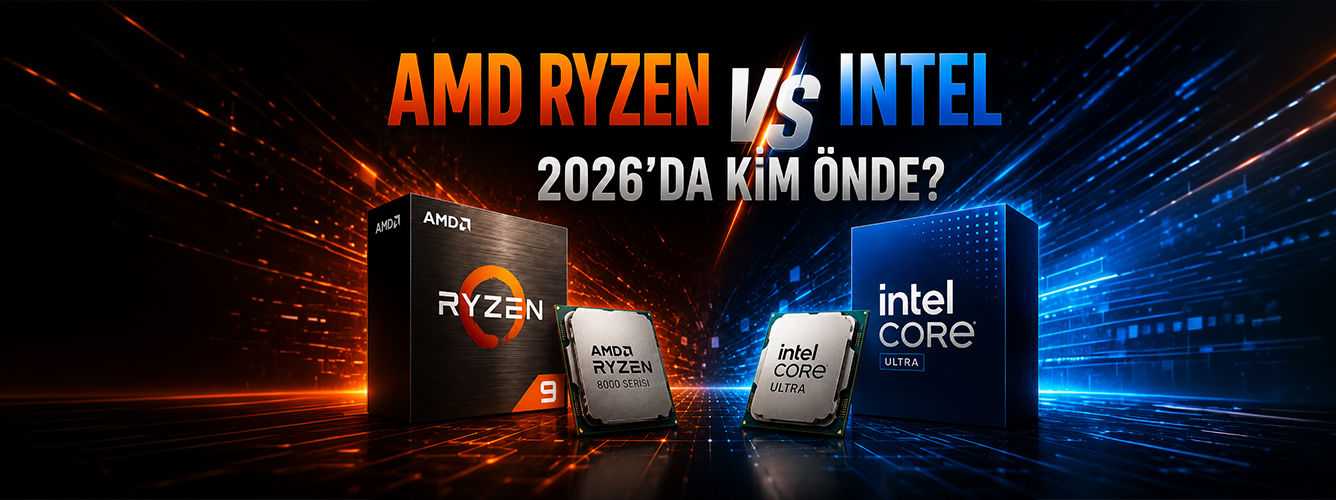
AMD Ryzen vs Intel
AMD Ryzen vs Intel: Who Leads in 2026?
A few years ago, the answer depended on the task: Intel for gaming and AMD for multi-core work was a common rule of thumb. In 2026, the picture is clearer, but that does not mean Intel is no longer useful. Both manufacturers have strengths; the differences between them are simply more distinct.
AMD Has a Powerful Advantage in Gaming
If you have heard of 3D V-Cache, here is the short explanation: AMD places an extra layer of cache on the processor. This lets the CPU access game data much faster than fetching it from main memory. The result can be substantial FPS gains, especially when the CPU is the bottleneck.
The Ryzen 7 9800X3D is currently regarded as one of the fastest gaming processors available. AMD's 3D V-Cache can offer a 10–20% advantage over Intel's most powerful models in CPU-heavy games. The gap can grow even larger in games that make extensive use of cache.
Has Intel Been Left Behind Completely?
No. Intel's Arrow Lake Refresh models, including the Core Ultra 7 270K Plus and Core Ultra 5 250K Plus, may not completely change the balance, but they keep the competition alive.
Intel remains strong in single-core performance. Its value in multi-core workloads is also noteworthy. The benefits of its hybrid architecture can be felt in content creation, video editing, software development and virtual-machine use.
Intel's P-core and E-core design can provide smooth multitasking by assigning background tasks to efficient cores and active workloads to performance cores.
Why Does the Platform Matter?
Performance alone is not enough when choosing a processor. Motherboard and socket longevity also have a major impact on total cost.
AMD's AM5 platform is designed to support Zen 6 and beyond. This increases the possibility of upgrading a system built today simply by replacing the processor in a few years.
Intel platforms can change more frequently, potentially requiring some users to replace the motherboard as well.
How Does the Choice Change with Budget?
High End
The Ryzen 7 9800X3D and Ryzen 9 9950X3D lead in gaming performance. In many scenarios, they can also use less power than Intel's flagship models.
Mid-Range
Intel's Arrow Lake Refresh models are highly competitive. AMD's Ryzen 5 9600X offers high efficiency and strong performance for gaming-focused systems.
Budget Segment
The Core Ultra 5 250K Plus and Ryzen 5 9600X compete closely. At this level, platform choice and future upgrade plans can matter more than small performance differences.
Power Consumption Matters More Now
Wattage used to attract less attention when choosing a CPU. Today, electricity use, cooling costs and quiet operation are important considerations.
Despite its high performance, the Ryzen 7 9800X3D can run efficiently. Intel's high-end models can consume more power and generate more heat under full load.
This is about more than electricity bills. Lower power consumption can mean:
- Lower temperatures
- Quieter fans
- More affordable cooling solutions
- A more comfortable system during extended use
Which Should You Choose?
For Gaming Only
AMD's Ryzen X3D series currently has a clear lead. The 7800X3D, 9800X3D and 9950X3D are exceptionally strong options in their respective tiers.
Gaming and Content Creation
If you stream, edit videos or render, the Ryzen 9 9950X is a strong choice. Intel remains a serious alternative if your Adobe-based workflow benefits from Quick Sync.
If Budget Comes First
When choosing between the Core Ultra 5 250K Plus and Ryzen 5 9600X, consider future upgrades as well as current performance.
Conclusion
AMD's gaming lead in 2026 is now widely recognized. It would still be wrong to dismiss Intel entirely: it remains competitive on a budget, strong in mixed workloads and advantageous in some professional software ecosystems.
The right question is less about AMD versus Intel in isolation and more about what you will use the computer for, your budget and how long you plan to keep the system.