

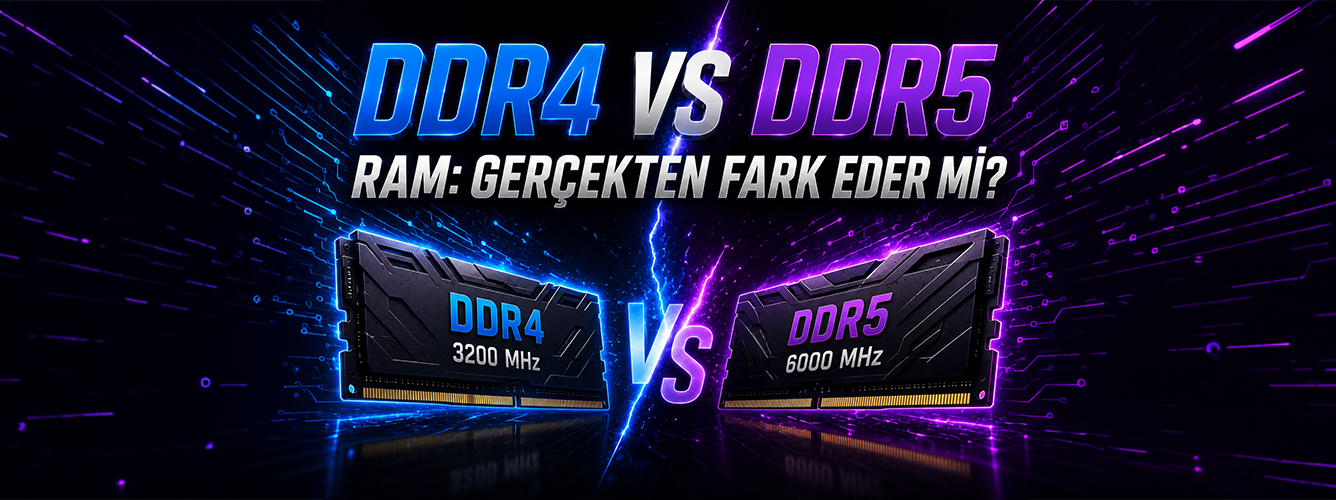
DDR4 vs DDR5 RAM
DDR4 vs DDR5 RAM: Does It Really Make a Difference?
You are building a new system and choosing a motherboard when two options appear: should you choose DDR4 support or DDR5? DDR5 is newer and looks faster, but the price is different too. Can you really feel the difference in games, content creation or everyday use?
The short answer: it depends heavily on the games you play and your setup. The longer answer is more interesting.
What Do the Numbers Say?
DDR5 theoretically offers much more bandwidth than DDR4. DDR4-3200 provides around 51GB/s of bandwidth, while DDR5-6000 can raise that to 96GB/s—almost double.
Those figures do not always translate directly into games, though, and that is where things get interesting.
Is the GPU or the CPU the Bottleneck?
The most overlooked point in the DDR4 vs DDR5 debate is that the difference changes dramatically depending on what is limiting the system.
Situations where the graphics card determines performance are common at 1440p and 4K. If the GPU is already running at full capacity in Cyberpunk 2077, Elden Ring or Alan Wake 2, faster RAM has only a limited effect. In most such cases, the difference between DDR4 and DDR5 is around 1–5%.
The situation changes when targeting high FPS at 1080p with low or medium settings. Competitive games such as CS2 and Valorant can become CPU-limited. RAM speed then has a direct effect on performance, with some tests showing FPS gains approaching 20% when moving from DDR4 to DDR5.
AAA Games Can Behave Differently
Beyond whether a game is CPU- or GPU-limited, there is also the question of how heavily it uses memory bandwidth.
Games such as Cyberpunk 2077, Watch Dogs Legion and Space Marine 2 can benefit significantly from higher bandwidth. Moving to DDR5 can bring performance gains of 15–30% in titles like these.
In optimized esports games such as CS2 and Valorant, the difference can be much smaller. Well-tuned DDR4 kits can sometimes even deliver more stable 1% low FPS results.
Latency: DDR5's Hidden Disadvantage
While bandwidth is DDR5's greatest strength, early generations had an important drawback: latency.
DDR4-3600 kits commonly offered CL16–18 timings, while early DDR5 kits had timings around CL40–46. This could make DDR4 feel faster in some games.
Today, kits such as DDR5-6000 CL30 have largely closed that gap. On modern AMD platforms in particular, this level is considered a good balance for many users.
Content Creation and Professional Use
Unlike games, applications such as video editing, 3D rendering and data processing use RAM bandwidth much more heavily.
The advantages of DDR5 are easier to notice in DaVinci Resolve, Blender and similar professional applications. Speed improvements of 15–25% are common in these workloads.
If you game while streaming with OBS, keeping dozens of browser tabs open and using Discord, DDR5 can provide a more comfortable multitasking experience.
Do Not Forget Capacity
DDR5 also brings larger capacity options per module. Modules of 32GB and 48GB are now much more common.
For users who want to upgrade to 64GB later, DDR5 offers a more flexible upgrade path.
Which Should You Buy?
DDR4 Makes Sense If
- Your budget is limited
- You are upgrading an existing DDR4 system
- You mainly game at 1440p or 4K
- Changing platforms would add unnecessary cost
Choose DDR5 If
- You are building a new system
- You want high FPS at 1080p
- You create content
- You plan to keep the system for four or five years
Capacity First, Speed Second
RAM choice is about more than the DDR generation. Capacity often makes a bigger difference than speed.
1. Enough capacity: 16GB minimum, ideally 32GB
2. RAM speed
3. DDR generation
In many situations, 16GB of DDR5 can perform worse than 32GB of DDR4. When memory fills up, the system starts using storage instead and performance drops sharply.
Conclusion
There is no single correct answer to the DDR4 vs DDR5 question. If you play GPU-limited games at high resolution, the difference can be quite small. In CPU-limited scenarios, high-FPS gaming and professional workloads, however, DDR5's advantages can become tangible.
For most users, replacing an existing DDR4 system just to change RAM generations does not make sense. For those building from scratch in 2026, though, DDR5 stands out as the more sensible long-term investment.